
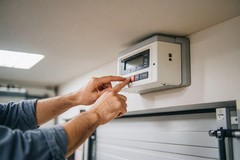
Few household annoyances rival the moment your garage door opener decides it no longer wants to cooperate. Maybe the remote clicks but nothing happens, the door reverses halfway down, or the keypad refuses your code. Before you assume the worst or reach for the phone to schedule garage door repair in Wausau, it helps to understand how to reset garage door opener systems yourself. In many cases, a quick reset clears up the glitch and gets you back to normal in a matter of minutes.
Openers are essentially small computers connected to a motor, and like any electronic device, they occasionally need a reboot. Power surges, dead batteries, misaligned sensors, and stored settings that get scrambled are all common culprits. The good news is that most fixes are straightforward and require no special tools. Below, we walk through the most useful resets so you can troubleshoot with confidence.
Start With the Simplest Reset: Power Cycling
When your opener behaves erratically, the first thing to try is a full power cycle. This is the equivalent of turning a frozen computer off and on again, and it resolves a surprising number of issues. Unplug the opener from the ceiling outlet, or if it is hardwired, switch off the corresponding breaker. Wait about thirty seconds so the unit fully discharges, then restore power.
After the opener powers back up, test the door using the wall button first, then your remote. If the door now moves normally, the reset did its job. Power cycling is especially effective after a storm or a brief outage, when a voltage fluctuation can leave the logic board in a confused state. If the problem returns quickly, that points to a deeper issue worth investigating further.
Resetting and Reprogramming Your Remote
Sometimes the opener works fine from the wall button but ignores the handheld remote. This usually means the remote lost its programming or the battery is fading. Start by replacing the remote battery, since a weak battery mimics a failed remote more often than people expect. If a fresh battery does not solve it, you will need to clear the old codes and reprogram.
Most openers have a "learn" button on the motor unit, often under a light cover or on the back panel. Pressing and holding this button for several seconds clears all stored remote codes, which is helpful if you moved into a new home or want to revoke access to a lost remote. Once the memory is cleared, press the learn button briefly, then press the button on your remote within the time window. The opener light typically flashes to confirm the pairing. Understanding how to reset garage door opener remotes this way is handy for keeping your system secure and responsive.
Fixing the Keypad and Exterior Access
Wireless keypads mounted outside the garage follow a similar logic. If your code stopped working, the keypad may have lost its connection or the code itself may have been erased during a power event. To restore it, clear the opener memory with the learn button, then reprogram the keypad by entering your desired PIN and pressing the button as directed by the manufacturer.
This is also a good moment to update your access code if you have not done so in a while, or if a former tenant, contractor, or house sitter once had it. Choosing a new PIN and reprogramming the keypad takes only a couple of minutes and gives you peace of mind. If the keypad still fails after reprogramming, moisture or corrosion inside the unit may be the problem, and replacement is often the simplest path forward.
Don't Overlook the Safety Sensors
When a garage door refuses to close and reverses back up, the safety sensors near the bottom of the tracks are usually to blame rather than the opener itself. These two small photo-eye units send an invisible beam across the doorway, and if that beam is blocked or the sensors fall out of alignment, the door will not close as a safety measure. This is often mistaken for an opener failure.
Check that both sensors are clean, free of cobwebs or debris, and pointing directly at each other. Most sensors have a small indicator light that glows steadily when properly aligned and blinks when something is wrong. Gently adjust the brackets until both lights are solid. Wiping the lenses with a soft cloth can also restore a beam that dust has weakened. Once the sensors are aligned, test the door again, and it should close smoothly. If you want to learn more about the equipment behind these systems, our overview of operators and garage door openers explains how the components work together.
Adjusting Travel Limits and Force Settings
If your door closes but then immediately reopens, or does not close all the way, the travel limits may need adjusting. Travel limits tell the opener exactly how far to move the door in each direction. Over time, these settings can drift, especially after a reset. Most openers have adjustment dials or buttons labeled for up and down travel. Small turns make a noticeable difference, so adjust gradually and test after each change.
Force settings, which control how much power the motor applies, can also cause reversal problems if they are set too sensitively. However, be cautious here. Force settings exist for safety, and setting them too high can create a hazard. If the door struggles to move because of a mechanical issue like worn rollers or a broken spring, no amount of adjustment will fix it, and forcing the opener to work harder can make matters worse. When in doubt, this is the point to bring in a professional.
When a Reset Isn't Enough
Knowing how to reset garage door opener systems solves the majority of everyday hiccups, but some symptoms signal something beyond a simple reboot. Grinding noises, a door that feels heavy or off balance, frayed cables, or a motor that hums without moving all suggest mechanical or electrical trouble. Attempting to force these problems away with repeated resets rarely helps and can occasionally cause additional damage.
Here is a quick reference for what a reset can and cannot fix:
- Resets usually solve: unresponsive remotes, scrambled codes, minor glitches after a power surge, and keypad access issues.
- Resets rarely solve: broken springs, snapped cables, bent tracks, worn gears, or a failing motor.
If you have worked through the steps above and your opener still misbehaves, it may be time for a trained technician to take a closer look. A Plus Doors LLC provides dependable garage door services in Wausau and neighboring communities, and our team can diagnose the difference between a quick fix and a repair that needs the right parts and expertise.
Learning how to reset garage door opener units is a valuable skill that saves time and often spares you a service call. Between power cycling, reprogramming remotes and keypads, aligning safety sensors, and checking travel limits, you have a solid toolkit for the most common problems. For everything else, our team is ready to help. Feel free to contact us for prompt, friendly garage door service across central Wisconsin whenever your garage door needs more than a reset.